Judicial Malfeasance

Systemic Speed of Post-Election Dismissals Precluded Forensic Evidence Presentation – Statewide (AZ)

Established Fact [Established Fact – Timing of dismissals vs. completion of audits] Multiple Arizona post-election challenges were dismissed in December 2020 – within weeks of election certification – on standing, mootness, or procedural grounds. The Cyber Ninjas audit was not completed until September 2021, and forensic analyses by Ben Cotton (CyFIR) and Jovan Pulitzer were […]

Systemic Speed of Post-Election Dismissals Precluded Forensic Evidence Presentation – Statewide (AZ) Read More »

Ward v. Jackson, No. CV2020-015285 (Ariz. S. Ct.) – Decision Rested on Proven Falsehood (AZ)

Reasonable Inference [Reasonable Inference – Court decision rested on incorrect factual predicate] In Ward v. Jackson, No. CV-20-0343-AP/EL (Ariz. Dec. 8, 2020), the Arizona Supreme Court rejected a challenge to the 2020 presidential election results in which the central dispute concerned the accuracy of ballot duplication — a process in which damaged or defective ballots

Ward v. Jackson, No. CV2020-015285 (Ariz. S. Ct.) – Decision Rested on Proven Falsehood (AZ) Read More »

Ward v. Jackson, No. CV2020-015285 (Ariz. S. Ct.) – Comingling & Representations by Government Counsel That Contradict Physical Record (AZ)

Established Fact [Established Fact – Representation was made; commingling was documented post-litigation] The Arizona Supreme Court adjudicated a challenge to the 2020 election results in which the Secretary of State’s counsel represented that original and duplicate ballots “are, by statute, segregated and preserved.” The Cyber Ninjas audit subsequently established that ballot boxes delivered for audit

Ward v. Jackson, No. CV2020-015285 (Ariz. S. Ct.) – Comingling & Representations by Government Counsel That Contradict Physical Record (AZ) Read More »

Bowyer v. Ducey, No. 2:20-cv-02321-DJH (D. Ariz.) – Dismissed for Standing; Claims Mischaracterized as Evidence Failure (AZ)

Reasonable Interference [Reasonable Inference – Characterization as evidence dismissal is misleading] A federal lawsuit alleging large-scale election fraud and seeking to decertify Arizona’s election results was dismissed for lack of legal standing. The presiding judge described the claims as “sorely wanting of relevant or reliable evidence” and noted entertaining the suit “would cause extreme and

Bowyer v. Ducey, No. 2:20-cv-02321-DJH (D. Ariz.) – Dismissed for Standing; Claims Mischaracterized as Evidence Failure (AZ) Read More »

Financial Audit Needed in Trump v. Biden – Wisconsin Supreme Court 4-3 Dismissal on Laches of Claims re: “Democracy in the Park,” Indefinitely Confined Voters, and Altered Certification Envelopes (WI)

Reasonable Inference [Reasonable Inference – As to financial audit need] In Trump v. Biden (Wis. Sup. Ct. 2020), the Wisconsin Supreme Court dismissed three of four election challenge claims under the doctrine of laches in a 4-3 decision. The dismissed claims included challenges to (1) the WEC’s absentee ballot distribution in “Democracy in the Park”

Financial Audit Needed in Trump v. Biden – Wisconsin Supreme Court 4-3 Dismissal on Laches of Claims re: “Democracy in the Park,” Indefinitely Confined Voters, and Altered Certification Envelopes (WI) Read More »

Trump v. Biden – Wisconsin Supreme Court 4-3 Dismissal on Laches of Claims re: “Democracy in the Park,” Indefinitely Confined Voters, and Altered Certification Envelopes (WI)

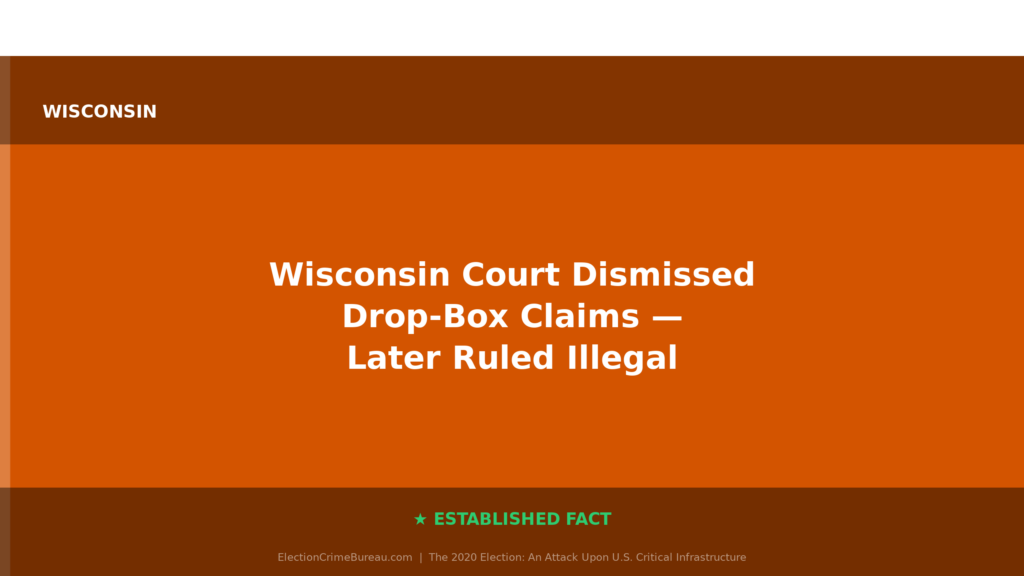
Established Fact [Established Fact – As to 4-3 ruling and dismissal basis] In Trump v. Biden (Wis. Sup. Ct. 2020), the Wisconsin Supreme Court dismissed three of four election challenge claims under the doctrine of laches in a 4-3 decision. The dismissed claims included challenges to (1) the WEC’s absentee ballot distribution in “Democracy in

Trump v. Biden – Wisconsin Supreme Court 4-3 Dismissal on Laches of Claims re: “Democracy in the Park,” Indefinitely Confined Voters, and Altered Certification Envelopes (WI) Read More »

Quid Pro Quo CEIR-Linked Private Funding of Legal Defense for Subpoenaed Election Officials (WI)

Reasonable Inference [Reasonable Inference – As to ethics violation and quid pro quo structure] The Wisconsin Office of the Special Counsel (OSC), led by former Wisconsin Supreme Court Justice Michael Gableman, documented in its Second Interim Investigative Report that the Election Officials Legal Defense Network (EOLDN) – an organization linked through funding networks to the

Quid Pro Quo CEIR-Linked Private Funding of Legal Defense for Subpoenaed Election Officials (WI) Read More »

Election Officials Legal Defense Network (EOLDN) – CEIR-Linked Private Funding of Legal Defense for Subpoenaed Election Officials; Providing “Anything of Value” to Procure Non-Compliance With Legislative Oversight (WI)

Established Fact [Established Fact – As to EOLDN existence and free counsel provision] The Wisconsin Office of the Special Counsel (OSC), led by former Wisconsin Supreme Court Justice Michael Gableman, documented in its Second Interim Investigative Report that the Election Officials Legal Defense Network (EOLDN) – an organization linked through funding networks to the Center

Election Officials Legal Defense Network (EOLDN) – CEIR-Linked Private Funding of Legal Defense for Subpoenaed Election Officials; Providing “Anything of Value” to Procure Non-Compliance With Legislative Oversight (WI) Read More »

Financial Incentives Behind Kelly v. Commonwealth – Pennsylvania Supreme Court Dismissal (PA)

Reasonable Inference [Reasonable Inference – As to investigative need for financial relationship audit] In Kelly v. Commonwealth, the Pennsylvania Supreme Court dismissed a facial constitutional challenge to Act 77 of 2019 – the statute authorizing universal no-excuse mail-in voting – on the doctrine of laches, ruling that plaintiffs had waited too long after the law’s

Financial Incentives Behind Kelly v. Commonwealth – Pennsylvania Supreme Court Dismissal (PA) Read More »

Kelly v. Commonwealth – Pennsylvania Supreme Court Dismissed Mail-In Ballot Constitutional Challenge on Laches Without Addressing Act 77’s Constitutionality (PA)

Established Fact [Established Fact – As to dismissal and its legal effect] In Kelly v. Commonwealth, the Pennsylvania Supreme Court dismissed a facial constitutional challenge to Act 77 of 2019 – the statute authorizing universal no-excuse mail-in voting – on the doctrine of laches, ruling that plaintiffs had waited too long after the law’s passage

Kelly v. Commonwealth – Pennsylvania Supreme Court Dismissed Mail-In Ballot Constitutional Challenge on Laches Without Addressing Act 77’s Constitutionality (PA) Read More »