
The Supreme Court has ruled that Congressman Mike Bost and similarly situated candidates do have constitutional standing to challenge Illinois’ practice of counting mail-in ballots received after Election Day, and sent the case back to the lower courts to consider the merits of the challenge.
What the Court Decided
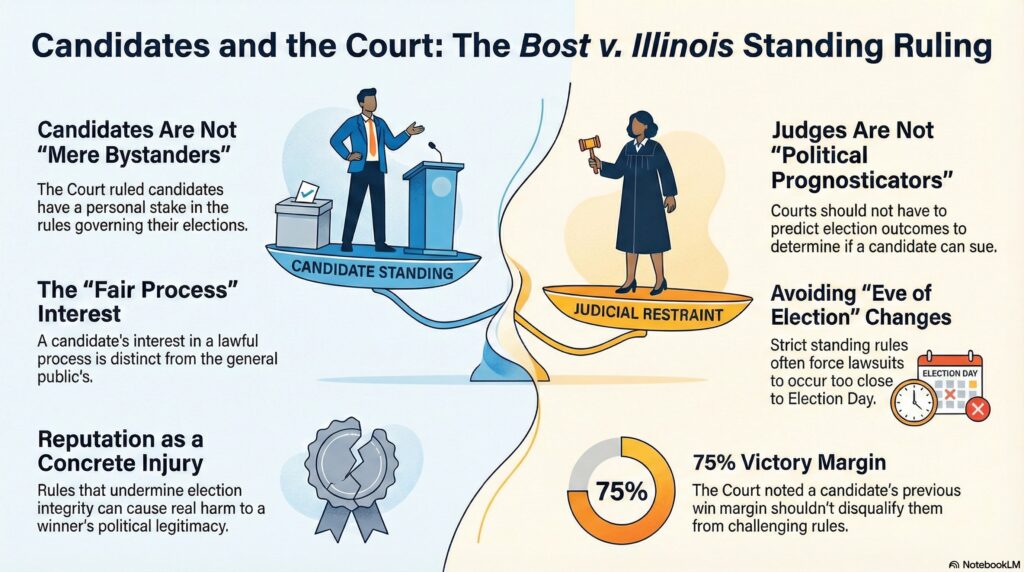
The Court held that a candidate for office has a concrete, personal stake in the rules that govern how votes are counted in his or her own election, even without proving the rule will change the outcome or vote margin.
The decision reverses the Seventh Circuit, which had dismissed Bost’s case for lack of standing, and remands the case for further proceedings on whether Illinois’ mail-ballot deadline violates federal Election Day statutes.
Illinois Mail-Ballot Rule at Issue
Illinois law requires officials to count mail-in ballots that are postmarked or certified by Election Day but received within 14 days after Election Day.
Bost and two other Republican candidates argued this extended receipt period conflicts with federal law setting a single federal Election Day for congressional and presidential elections.
Roberts’ Majority Opinion
Chief Justice Roberts, writing for the Court, said unlawful election rules can injure candidates by forcing them to spend extra resources, affecting vote share, damaging reputation, and—apart from all that—by denying them a fair and lawful process.
The Court emphasized that candidates are “not mere bystanders” in their own elections and have a particularized interest in the integrity and perceived legitimacy of the vote-counting rules.
Barrett Concurrence, Jackson Dissent
Justice Barrett agreed Bost has standing but criticized the majority’s broad theory, saying standing should rest on traditional “pocketbook” injury: Bost’s need to spend money and resources on monitoring late-arriving ballots.
Justice Jackson, joined by Justice Sotomayor, dissented, warning that the new candidate-standing rule abandons the usual “actual injury” requirement and risks opening the door to more post- and pre‑election litigation over election rules without proof of concrete harm.