

On August 2007, there were a series of emails between Smartmatic employees based in Venezuela to Sequoia voting systems employees based in the U.S. that provided instructions for the installation of a Remote Access Server (RAS). This RAS would enable Venezuelan Smartmatic employees to access Sequoia’s U.S. based election systems responsible for reporting election results.
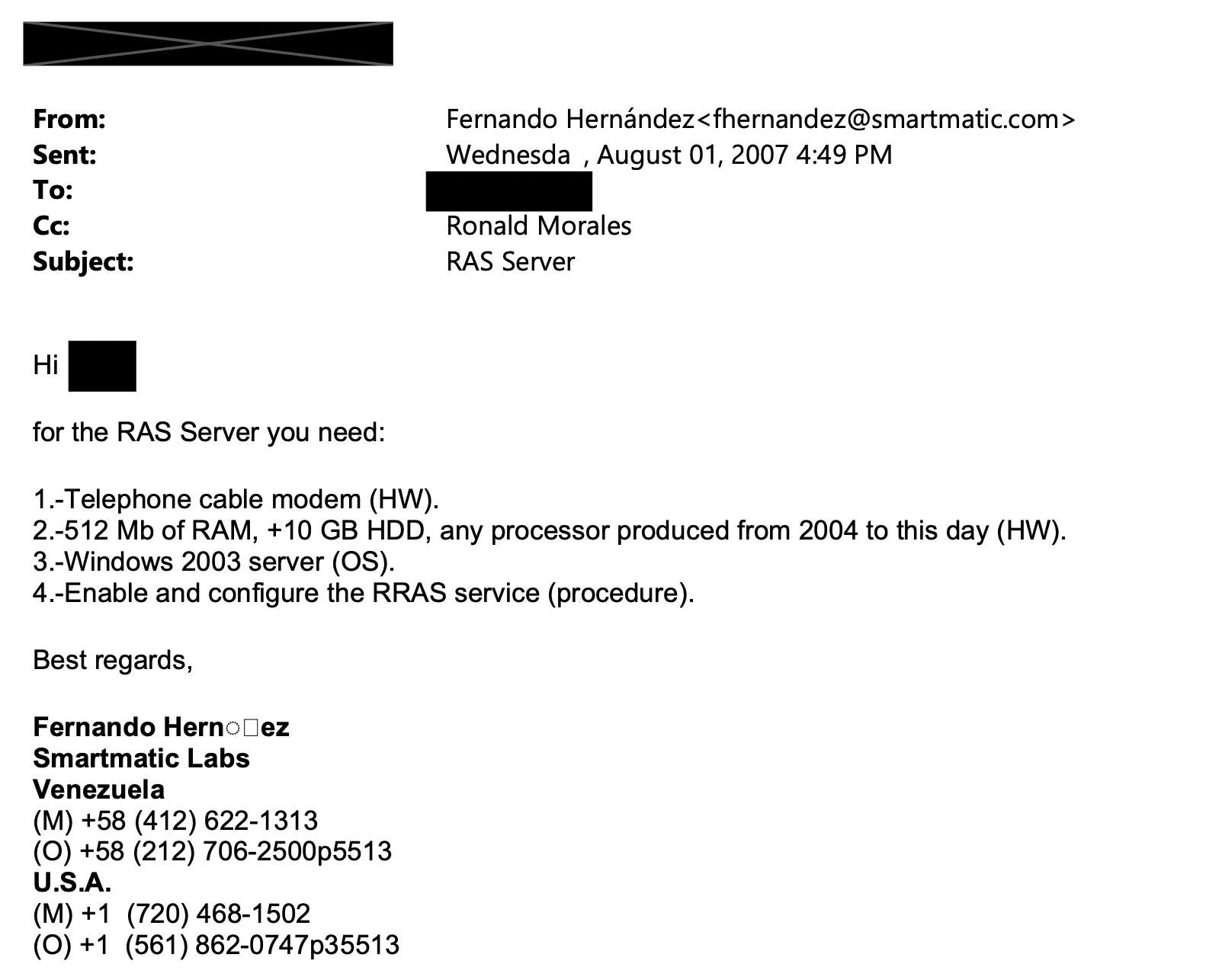
On August 1, 2007, Fernando Hernández of Smartmatic Labs in Venezuela sent an email to Ronald Morales of Sequoia Voting Systems with the subject line “RAS Server.” The email laid out a concise list of components needed for the server.
The required components were:
- Telephone cable modem (HW) (This is a hardware requirement for establishing network connectivity.)
- 512 Mb of RAM, +10 GB HDD, any processor produced from 2004 to this day (HW). (These are the basic hardware specifications for the computer, including memory, storage, and processing power.)
- Windows 2003 server (OS). (This specifies the required operating system for the server.)
- Enable and configure the RRAS service (procedure). (This refers to the software configuration of the Routing and Remote Access Service, a feature within the Windows Server operating system.)
The explicit identification of the sender, Fernando Hernández, with “Smartmatic Labs, Venezuela,” in his email signature is a key detail, confirming that the technical instructions for a component of a U.S. voting system originated from outside the country. This initial directive prompted a series of implementation discussions and questions within Sequoia Voting Systems.
The internal communications that followed the initial directive provide a valuable window into how the project was being processed by Sequoia personnel. These emails reveal the technical questions that arose, the intended application of the RAS server, and the scope of the project as perceived by the team responsible for its implementation.
The follow-up discussions occurred over several days:
- August 2, 2007: A Sequoia employee sought clarification from Fernando Hernández on the final step of his instructions, asking directly: “Thanks for the information. I have a question, how do I complete number 4?”. This indicates a need for more detailed guidance on configuring the RRAS service.
- August 2, 2007: Hernández’s response was brief and deferred to local expertise: “Sorry, I don’t know,” he replied, adding, “For sure, the new IT guy working here in the Denver office will know.”
- August 6, 2007: On this day, the same Sequoia Quality Assurance Analyst was engaged in multiple, parallel conversations that shed light on the project. In an email to a colleague primarily discussing challenges with a separate “reporting tool,” the analyst revealed the server’s intended destination, stating, “…all I know to work on is trying to prepare machines for the HAAT Listener and the RAS Server we need for Wisconsin.” He underscored the significance of the task, noting, “That’s going to be a major project.”
- August 6, 2007: In a separate email sent just over an hour later to another colleague, the same analyst discussed hardware and software requirements. After noting, “It looks like a D610 laptop or comparable will work for both the HAAT Listener and RAS servers,” he inquired about a different operating system than the one specified by Hernández: “Do we have or can we get SUSE Linux 9.3?” This exploration of an alternative operating system is typical of a project’s early stages but also shows that the initial specifications from Smartmatic were not being treated as immutable directives.
These factual technical discussions would later support speculations about the server’s ultimate purpose.
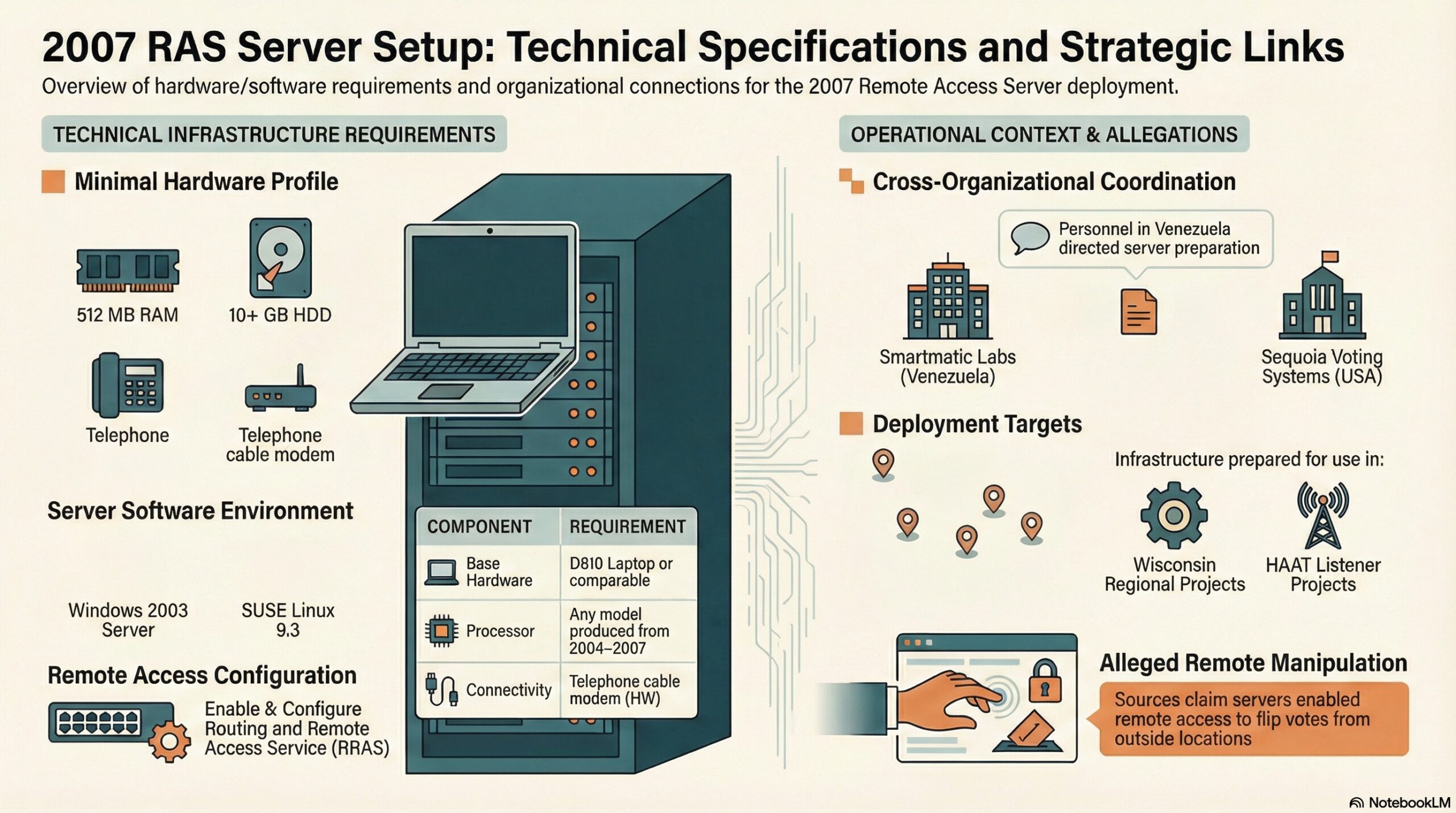
The 2007 emails open the door to allegations of a premeditated plot to compromise election integrity. This interpretation casts the creation of the Remote Access Server not as a standard IT project, but as the deliberate construction of a tool for election manipulation.
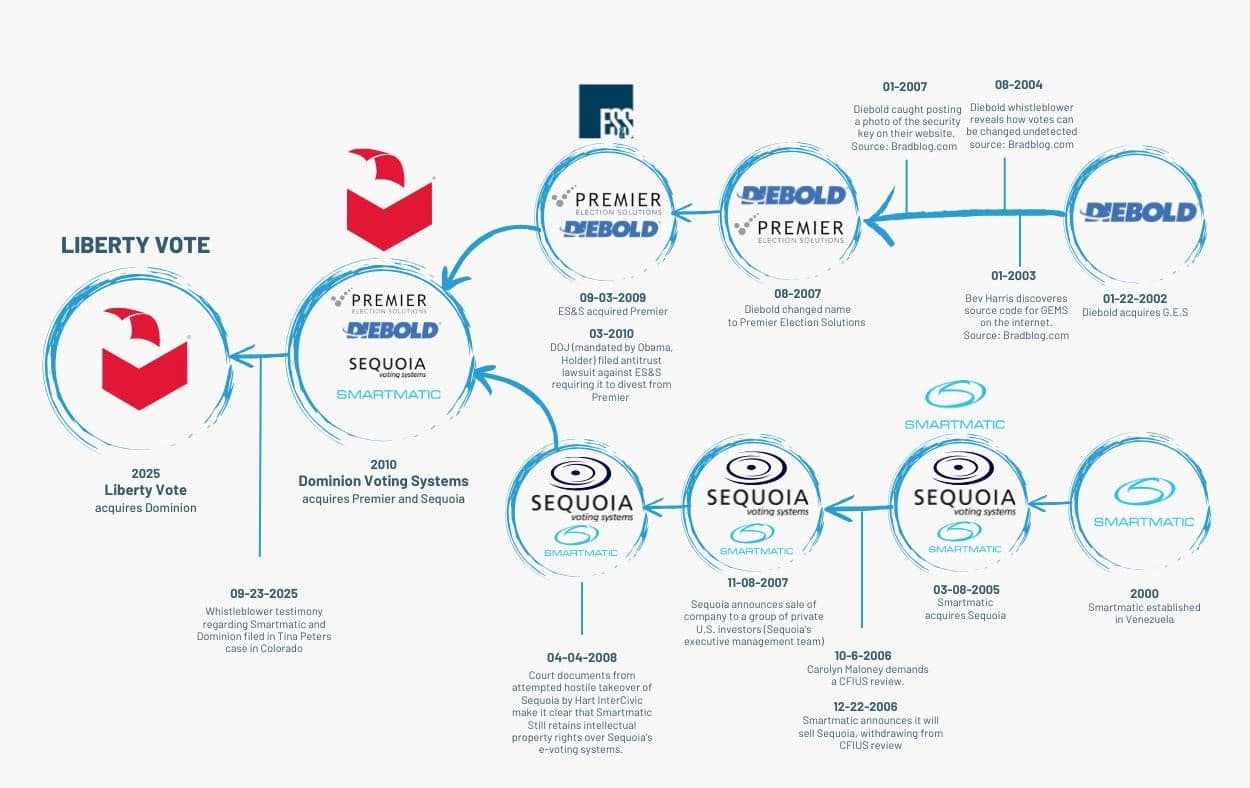
A crucial element of the overall allegation is the link between Sequoia Voting Systems, the company at the center of the 2007 emails, and Dominion Voting Systems, now rebranded as Liberty Vote. This connection seems to indicate an unbroken chain of ownership and intent, tying the events of 2007 directly to the security of today’s elections in the U.S..
Conclusion
The undisputed facts derived from the emails are as follows:
- A Smartmatic employee based in Venezuela provided technical specifications for a Remote Access Server to Sequoia Voting Systems in August 2007.
- Sequoia intended to use this RAS server in connection with voting systems for Wisconsin.
- Internal communications at Sequoia show ongoing technical planning, including questions about configuration and consideration of different operating systems.
Upon evaluation of these facts, there is at least the possibility that the RAS project was, in fact, a system designed for remote vote manipulation from Venezuela and that Sequoia’s corporate legacy, along with its alleged vulnerabilities, was passed directly to Dominion Voting Systems which is now known as Liberty Vote.