
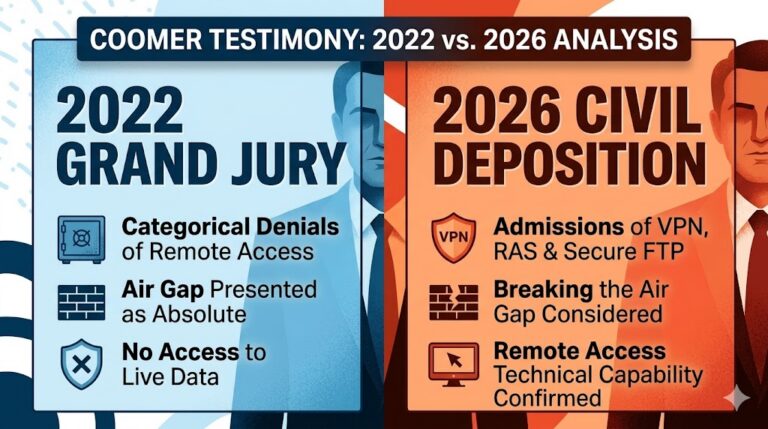
There is significant evidence of contradictory sworn statements made by Dr. Eric Coomer, a former high-ranking official at Dominion Voting Systems, across two legal proceedings: a 2022 grand jury and a 2026 civil deposition. The following analysis reveals a substantial shift in testimony regarding four critical areas: internet connectivity and “air gaps,” Dominion’s access to live jurisdictional data, Dr. Coomer’s specific technical role, and the involvement of foreign development teams in U.S. election software.
In 2022, Dr. Coomer’s testimony was characterized by categorical denials of remote access and internet connectivity. By 2026, he admitted to the existence of Virtual Private Network (VPN) configurations, Remote Access Servers (RAS), and secure FTP infrastructure used to transmit live tally data. Furthermore, while Dr. Coomer identified as a “Chief Software Architect” in 2022, he explicitly denied writing code or designing systems in 2026. These discrepancies represent a material departure from the narrative provided to the grand jury investigating election interference.
Internet Connectivity and the “Air Gap” Assertion
The most significant contradictions involve the physical and digital isolation of voting equipment. In 2022, the testimony presented the systems as entirely closed; in 2026, the existence of remote access capabilities was acknowledged.
The “Never Connected” Claim
In 2022, Dr. Coomer provided unqualified denials regarding internet connectivity for ImageCast Precinct (ICP) and ImageCast X (ICX) machines:
- 2022 Statement: “The individual ICX’s and ICP’s… are not ever connected to the internet.”
- 2026 Admission: Dr. Coomer confirmed that during a 2020 primary in a major city, a VPN was configured specifically for him to remotely access the Election Management System (EMS). He noted that city IT staff discussed how they could “break that air gap and allow [him] to VPN into the server.”
Remote Access Servers (RAS) and Modems
While the 2022 testimony suggested a completely air-gapped environment, the 2026 deposition detailed specific infrastructure used for remote transmission:
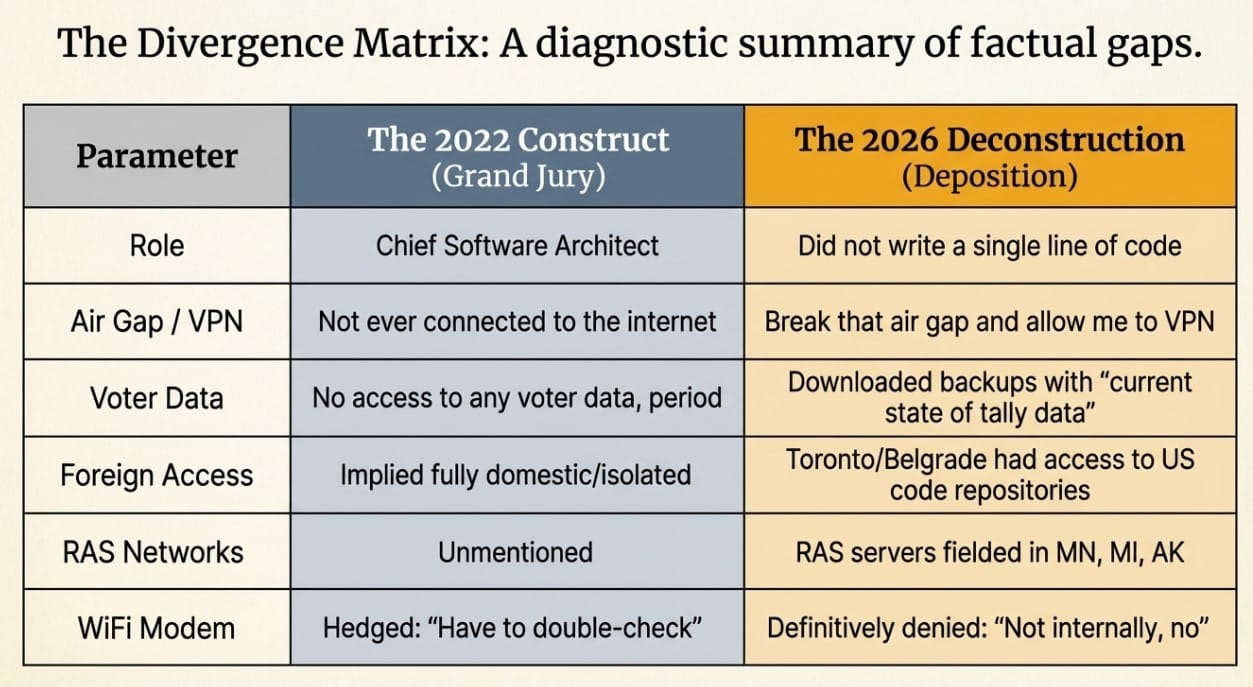
- Deployment of RAS: Coomer admitted that “Sequoia fielded some number of RAS servers” in Minnesota, and potentially Michigan and Alaska.
- Analog Modems: These servers were required to accept transmissions of unofficial results from jurisdictions using analog modems.
- Test Environments: Contractors had the ability to remote into test hardware and systems within Dominion offices.
Feature | 2022 Grand Jury Testimony | 2026 Civil Deposition |
Internet Connection | Absolute “No.” | Admitted VPN was configured as a contingency. |
Air Gap | Presented as impenetrable and absolute. | Acknowledged plans to “break” the air gap if necessary. |
Remote Access | Claimed no “technical capability” to access. | Confirmed remote desktop capabilities for EMS access. |
Access to Jurisdictional Data and Live Tallies
In 2022, Dr. Coomer testified that Dominion was insulated from voter data. The 2026 testimony contradicted this by describing routine data transfers and active monitoring.
Secure FTP and Database Backups
- 2022 Position: Dr. Coomer stated, “Dominion doesn’t have any access to any voter data, period.” He argued that the only access would be if a county physically handed over a copy.
- 2026 Position: Coomer acknowledged the use of secure FTP sites where jurisdictions uploaded election database backups for troubleshooting. He confirmed these backups contained the “current state of tally data.”
Election Night Monitoring
Despite telling the grand jury that Dominion had “no direct access” to manipulate or access numbers, Coomer admitted in 2026 that he personally monitored election results through the reporting system on election night 2020 for at least one major jurisdiction after the polls closed but before certification.
Professional Identity and Technical Responsibilities
There is a direct conflict regarding Dr. Coomer’s actual job function and his role in the creation of Dominion’s software.
Title Discrepancies
- 2022 Testimony: Identified himself as the “Chief Software Architect and Security Product Specialist.”
- 2026 Testimony: Identified as the “senior director of product strategy and security.” He explicitly distinguished this from being a “director of products,” stating there was a “huge difference.”
Coding and Design Responsibilities
In 2026, Dr. Coomer distanced himself from the technical architecture he previously claimed to lead:
- Design/Programming: He testified, “I had no role in the design, programming, or the securitization of the databases used in the Dominion voting system.”
- Code Creation: He stated multiple times that he “did not write a single line of code for Dominion product” and “did none of the programming.”
International Operations and Code Security
The 2022 testimony did not disclose the multinational nature of Dominion’s software development or the remote access held by foreign offices.
Global Connectivity
In 2026, Coomer confirmed that Dominion operated as a multinational entity with “direct remote connections” between its offices in Denver, Toronto, and Belgrade (Serbia).
Foreign Access to U.S. Election Code
- Code Repositories: Coomer admitted that development teams in Serbia and Canada had access to the code repositories for U.S. election equipment.
- Statement of Fact: When asked if foreign developers could remotely work on the code base for U.S. systems, he answered “Yes.”
Conclusion: Evaluation of Factual Divergence
The transition from the 2022 testimony to the 2026 deposition reveals a move from categorical, simplified denials to a more complex reality involving networked capabilities.
- Connectivity: The 2022 narrative of a “fully air-gapped” system was replaced by admissions of VPN configurations, RAS servers, and modem transmissions.
- Data Handling: The claim that Dominion had “no access, period” to data was contradicted by the admission of FTP-based live tally transfers and active election-night monitoring by Coomer himself.
- Security Oversight: The non-disclosure of foreign developer access to U.S. election code in 2022 contrasts with the 2026 admission of a globally connected development infrastructure.
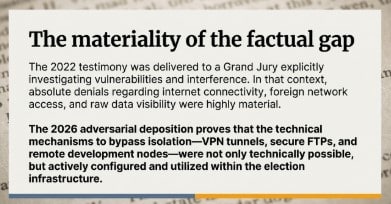
The 2022 grand jury was presented with an image of a system that was physically and digitally isolated from both Dominion staff and the internet. The 2026 deposition established that the technical capability for remote access and data transmission was not only present but was part of the system’s operational and troubleshooting framework.
This contradiction undermines the assertions made by Dominion CEO John Poulos under oath before the Michigan Senate during his December 15, 2020. Poulos’ testimony served as the basis for many of the false assertions made in the 2021 Michigan Senate Report on the Michigan elections. This report in turn was referenced in many 2020 election cases as a basis for dismissal of lawsuits or the adjudication election lawsuits in favor of those who asserted that the 2020 election was secure.
In short, these contradictions expose the narrative that the 2020 election was “the most secure election in American history” as a lie.