United States

No Declassified IC Assessment Specifically Identifying ActBlue as Foreign Exploitation Vehicle (US)

Established Fact No declassified U.S. intelligence community assessment reviewed for this report specifically identifies ActBlue as a vehicle for foreign national contribution fraud during the 2020 cycle. This represents a significant evidentiary absence requiring ODNI/FBI inquiry. Citations Review of publicly available ODNI and FBI declassified assessments re: 2020 election foreign interference (no ActBlue-specific finding identified
No Declassified IC Assessment Specifically Identifying ActBlue as Foreign Exploitation Vehicle (US) Read More »

Prepaid Debit Cards — No Verified Exclusion from ActBlue Payment Methods (US)

Disputed Fact Prepaid debit cards, obtainable in many jurisdictions without identity verification, were not confirmed as excluded from ActBlue’s accepted payment methods during the 2020 cycle. Their acceptance would further reduce barriers to anonymous or foreign-sourced contributions. Citations ActBlue, Payment Methods Accepted (archived web page, 2020–2021) Stripe Developer Documentation, https://stripe.com/docs/radar/rules  (not specific to ActBlue implementation)

Prepaid Debit Cards — No Verified Exclusion from ActBlue Payment Methods (US) Read More »

CVV/AVS Gap as Potential Foreign Contribution Vector (US)

Reasonable Inference Security researchers contend ActBlue’s relaxed CVV and Address Verification System (AVS) configuration would have reduced technical barriers to foreign-based actors using prepaid cards or VPNs to submit contributions without triggering identity mismatch rejections. Citations Logan Washburn, ‘Amid Chaos At ActBlue, House Republicans Seek Answers About ‘Potentially Fraudulent And Illicit Financial Activity,’ The Federalist,

CVV/AVS Gap as Potential Foreign Contribution Vector (US) Read More »

ActBlue Enables Illegal Foreign National Contributions

Reasonable Inference ActBlue security negligence enables illegal foreign national contributions. 52 U.S.C. § 30121 law prohibits foreign nationals from making any direct or indirect contribution in connection with any U.S. election. Receiving committees are also prohibited from soliciting, accepting, or receiving such contributions. Felony threshold: >$25,000/year. Citations John Solomon, ‘Questions mount about ActBlue’s security,’ Just

ActBlue Enables Illegal Foreign National Contributions Read More »

ActBlue Donation Profiles Are Straw Donations (US)

Disputed Fact ActBlue Smurf donation profiles appear to violate federal law. 52 U.S.C. § 30122 (US) prohibits making a contribution in the name of another person, permitting one’s name to be used for such a contribution, or knowingly accepting a contribution made in another’s name. Criminal penalties attach at >$2,000 (misdemeanor) and >$25,000/year (felony). Citations

ActBlue Donation Profiles Are Straw Donations (US) Read More »

ActBlue Leverages FEC Reporting Loophole By Using Straw Donors Used (US)

Reasonable Inference Where a coordinating actor directs multiple nominal donors to make contributions earmarked for a common recipient, those contributions are attributed to the original source — not the nominal donor — and aggregate against that source’s individual contribution limits. The conduit or intermediary is required to report the original source and intended recipient to

ActBlue Leverages FEC Reporting Loophole By Using Straw Donors Used (US) Read More »

Address Clustering — Same Address, Multiple Donor Names, Near-Simultaneous Contributions (US)

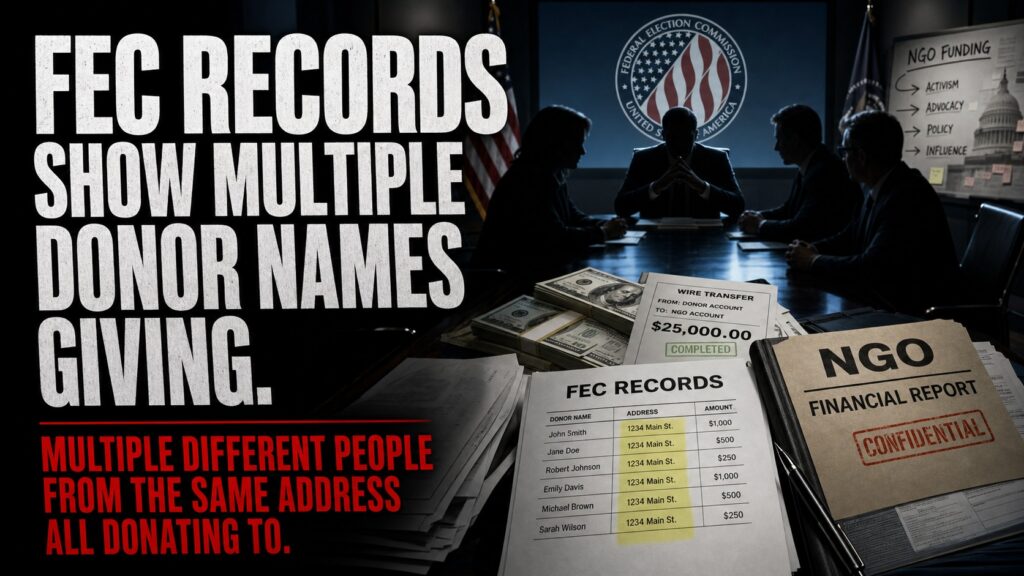
Established Fact Instances appear in public FEC records in which the same physical address is associated with multiple donor names making near-simultaneous contributions to the same recipients — a pattern consistent with identity fabrication or credential harvesting at a single address. Citations “ActBlue wrote to Sift specifically about its failure to detect a fraud campaign

Address Clustering — Same Address, Multiple Donor Names, Near-Simultaneous Contributions (US) Read More »

Geographic Clustering — High Contribution Rates in Low-Income Zip Codes (US)

Disputed Fact FEC data analysis identified contribution patterns attributed to donors whose listed occupations are unemployed, retired, or on fixed income at frequencies and aggregate amounts inconsistent with known demographic donation behavior — a population that historically accounts for a negligible share of political giving. Separate analysis confirmed that tens of thousands of donor identities

Geographic Clustering — High Contribution Rates in Low-Income Zip Codes (US) Read More »

Anomalous Sub-threshold Contribution Clustering in FEC Data (US)

Established Fact Analysis of public FEC filings identified statistically anomalous frequencies of contributions in exact round-dollar amounts ($1, $5, $10, $15) attributed to single named donors over compressed time periods — a pattern inconsistent with typical individual donor behavior. Citations Analysis of FEC bulk data (Schedule A filings), FEC.gov, https://www.fec.gov/data/browse-data/?tab=bulk-data Election Research Institute, Anomalous Contribution

Anomalous Sub-threshold Contribution Clustering in FEC Data (US) Read More »

Congressional Referral Letters to DOJ and FEC (2023–2024) (US)

Established Fact Members of the House Administration and Judiciary Committees transmitted formal letters to the DOJ and FEC requesting investigation of ActBlue’s donor verification practices, citing constituent complaints and FEC data anomalies. Citations Formal letter from House Administration Chairman Bryan Steil, Judiciary Chairman Jim Jordan, and Oversight Chairman James Comer to U.S. Attorney General Pam

Congressional Referral Letters to DOJ and FEC (2023–2024) (US) Read More »