Top 10 Assertions Made By Supporters of Electronic Voting Systems
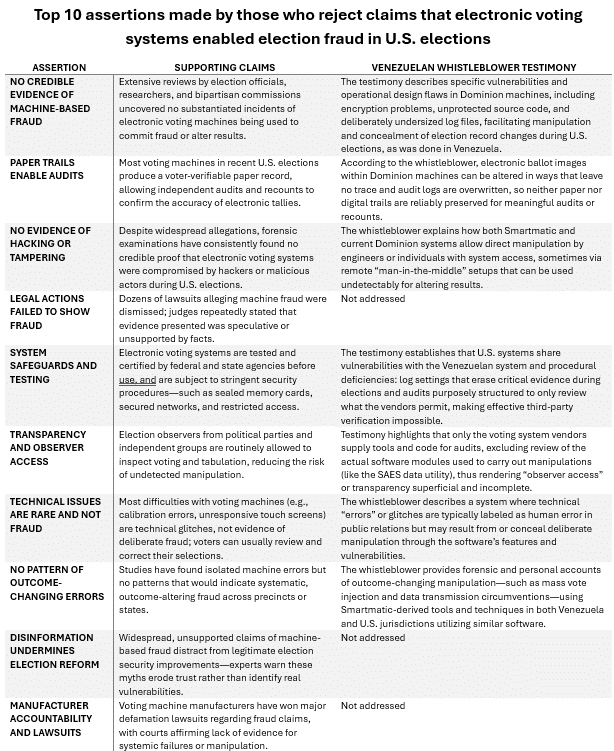
Extensive reviews by election officials, researchers, and bipartisan commissions uncovered no substantiated incidents of electronic voting machines being used to commit fraud or alter results.
WHAT THEY DON”T TELL YOU…
The testimony of Venezuelan whistleblower describes specific vulnerabilities and operational design flaws in Dominion machines, including encryption problems, unprotected source code, and deliberately undersized log files, facilitating manipulation and concealment of election record changes during U.S. elections, as was done in Venezuela.
Most voting machines in recent U.S. elections produce a voter-verifiable paper record, allowing independent audits and recounts to confirm the accuracy of electronic tallies.
WHAT THEY DON”T TELL YOU…
According to the Venezuela whistleblower, electronic ballot images within Dominion machines can be altered in ways that leave no trace and audit logs are overwritten, so neither paper nor digital trails are reliably preserved for meaningful audits or recounts.
Despite widespread allegations, forensic examinations have consistently found no credible proof that electronic voting systems were compromised by hackers or malicious actors during U.S. elections.
WHAT THEY DON’T TELL YOU…
The Venezuelan whistleblower explains how both Smartmatic and current Dominion systems allow direct manipulation by engineers or individuals with system access, sometimes via remote “man-in-the-middle” setups that can be used undetectably for altering results.
Dozens of lawsuits alleging machine fraud were dismissed; judges repeatedly stated that evidence presented was speculative or unsupported by facts.
WHAT THEY DON’T TELL YOU…
In one of the only courts to have allowed substantive discovery allowing forensic examination of electronic voting systems, Judge Kevin Elsenheimer issued the following statement in his decision to dismiss the Bailey v Antrim County lawsuit:
“As an aside, the Court would note that at its core, this case has involved, from the beginning, something that we all learned to do in kindergarten, and that is count. We’ve, over time, and perhaps with good reason, in the conduct of our elections, taken this very simple function and made it into a complex and often computerized exercise. By deciding this motion, the Court is not saying that there were no problems in the way that Antrim County conducted its November 2020 elections.”
Electronic voting systems are tested and certified by federal and state agencies before use, and are subject to stringent security procedures—such as sealed memory cards, secured networks, and restricted access.
WHAT THEY DON’T TELL YOU…
The Venezuelan whistleblower testimony establishes that U.S. systems share vulnerabilities with the Venezuelan system and procedural deficiencies: log settings that erase critical evidence during elections and audits purposely structured to only review what the vendors permit, making effective third-party verification impossible.
Election observers from political parties and independent groups are routinely allowed to inspect voting and tabulation, reducing the risk of undetected manipulation.
WHAT THEY DON’T TELL YOU…
Testimony of Venezuelan whistleblower highlights that only the voting system vendors supply tools and code for audits, excluding review of the actual software modules used to carry out manipulations (like the SAES data utility), thus rendering “observer access” or transparency superficial and incomplete.
Most difficulties with voting machines (e.g., calibration errors, unresponsive touch screens) are technical glitches, not evidence of deliberate fraud; voters can usually review and correct their selections.
WHAT THEY DON’T TELL YOU…
The Venezuelan whistleblower describes a system where technical “errors” or glitches are typically labeled as human error in public relations but may result from or conceal deliberate manipulation through the software’s features and vulnerabilities.
Studies have found isolated machine errors but no patterns that would indicate systematic, outcome-altering fraud across precincts or states.
WHAT THEY DON’T TELL YOU…
The Venezuelan whistleblower provides forensic and personal accounts of outcome-changing manipulation—such as mass vote injection and data transmission circumventions—using Smartmatic-derived tools and techniques in both Venezuela and U.S. jurisdictions utilizing similar software.
Widespread, unsupported claims of machine-based fraud distract from legitimate election security improvements—experts warn these myths erode trust rather than identify real vulnerabilities.
WHAT THEY DON’T TELL YOU…
The U.S. Congress Weaponization of Government Subcommittee issued a report indicating that the “disinformation” was being promoted by those supporting the use of electronic voting systems. The report finds that “disinformation” efforts connected to the Election Integrity Partnership (EIP) and federal agencies led to the censorship of Americans’ online political speech in the lead-up to the 2020 election. It documents systematic coordination between universities, government (notably the Department of Homeland Security and its Cybersecurity and Infrastructure Security Agency), and major social media platforms to flag and suppress content—often true information, jokes, and political opinions. These actions targeted core political speech, included disproportionate censorship of conservative viewpoints, and suppressed criticism of election processes and results.
Voting machine manufacturers have won major defamation lawsuits regarding fraud claims, with courts affirming lack of evidence for systemic failures or manipulation.
WHAT THEY DON’T TELL YOU…
Illusory provisions such as prohibitions against inspection or analysis of hardware or software within contracts prevent accountability.